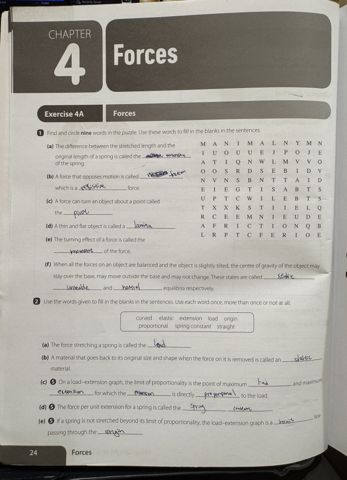
(a) extension, (c) pivot, (d) lamina, (e) moment, (f) stable/unstable/neutral — all correct. Only (b)'s first blank is hard to read in the photo; double-check the named force that opposes motion.
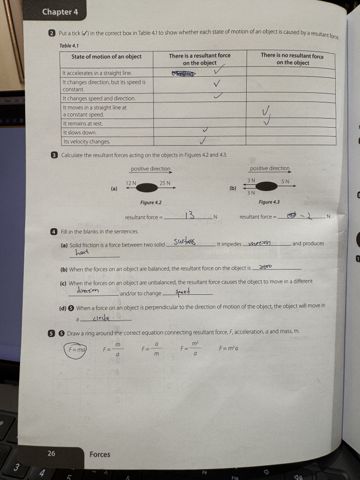
Try this → (b) Looked it up on the clean figure: there are TWO 3 N arrows, both pointing left (negative), and one 5 N pointing right. Add all three with signs ($+5-3-3$). You wrote −2 — did you include BOTH 3 N forces?
Qp26 · Q4 (fill the blanks)✓ Correctfriction & balanced forces
surfaces/motion/heat, zero, direction/speed, circle — all correct.
Qp26 · Q5 (F = ma)✓ CorrectNewton's 2nd law
Ringed $F=ma$ ✓.
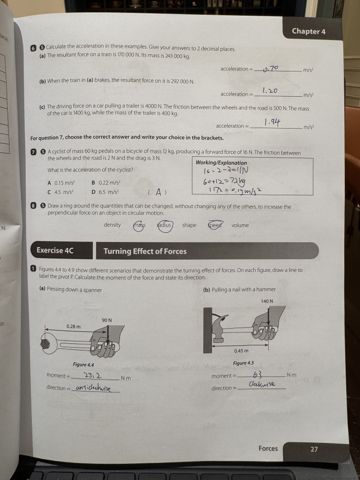
Qp27 · Q6 (acceleration)✓ Correcta = F/m
(a) 0.70, (b) 1.20, (c) 1.94 m/s² — all correct, including the (c) two-mass + friction case.
Qp27 · Q7 (cyclist MCQ)✓ Correctresultant force then a = F/m
A (0.15 m/s²) with full working ($16-2-3=11$ N, $60+12=72$ kg, $11/72$) — exactly the right habit.
Qp27 · Q8 (circular motion)✓ Correctwhat changes centripetal force
mass / radius / speed ✓.
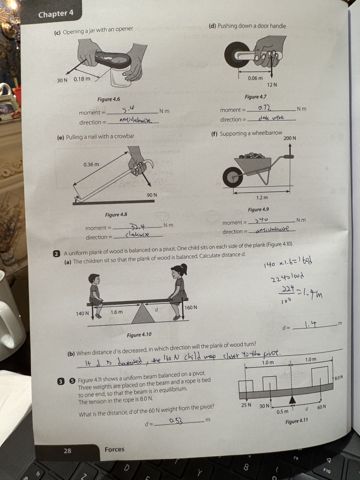
Qp27–28 · Q1 (4C moments)✓ Correctmoment = F × d
All six moments correct: 25.2, 63, 5.4, 0.72, 32.4, 240 N m. Just double-check each direction label against the arrow in its figure.
Qp28 · Q2 (seesaw)◐ Partialprinciple of moments
(a) $140\times1.6 = 160d \Rightarrow d = 1.4$ m ✓.
Try this → (b) You described what happens to the 160 N child but didn't answer the question — which WAY does the plank turn when $d$ decreases? (Which side's moment now wins?)
Try this → Checked the clear figure — the distances are easy to misassign, and your $d=0.53$ m is actually plausible under one reading. Write out your full moment equation (each force × its distance about the pivot, including the 8.0 N rope) so it can be confirmed.
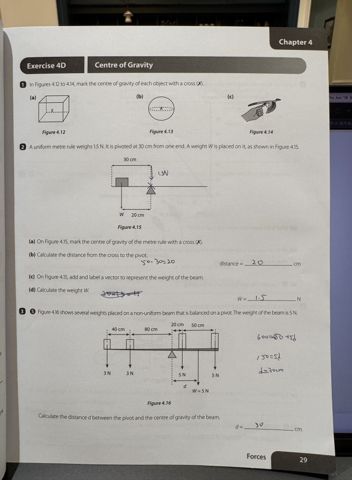
Qp29 · Q1 (mark centre of gravity)✓ Correctcentre of gravity
Crosses placed for the cube, circle and tool.
Qp29 · Q2 (metre rule)◐ Partialmoments on a pivoted rule
Try this → (d) Check where the weight $W$ sits relative to the pivot, then use moments: $W \times (\text{its distance}) = 1.5\,\text{N} \times 20\,\text{cm}$. Your 1.5 N looks like the rule's own weight, not the calculated $W$.