Mathematics (IGCSE, Grade 9) · Textbook Exercise 3.4, Q1–12
Math Exercise 3.4 — Factorising & Solving Cubics
Graded 2026-06-17 · Sys4Ethan (Claude Opus 4.8 vision, human-verified)
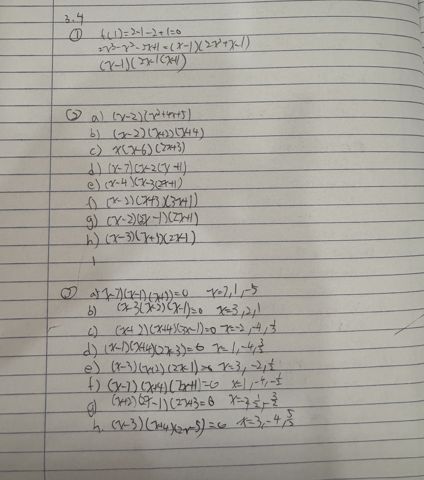
Q1
✓ Correct
factor theorem + factorise
$x-1$ shown as a factor, then full factorisation $(x-1)(2x-1)(x+1)$.
Q2
✓ Correct
factorise cubics completely (a–h)
All eight parts factorised completely and correctly — excellent.
Q3
✓ Correct
solve cubic equations (a–h)
All eight solved; roots correct.
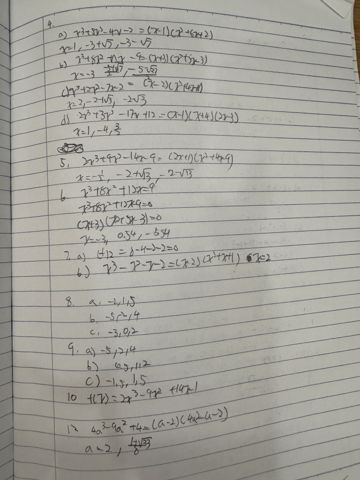
Q4
✓ Correct
roots in surd form (a–d)
Surd roots via the quadratic formula — all correct.
Q5
✓ Correct
surd roots
$x=-\tfrac12,\ -2\pm\sqrt{13}$.
Q6
✓ Correct
solve to 2 d.p.
$x=-3,\ 0.54,\ -5.54$.
Q7
✓ Correct
one real root argument
Good. For full marks, state explicitly that $x^2+x+1$ has no real roots (its discriminant is negative).
Q8
◐ Partial
form $f(x)$ from roots (coeff 1)
Try this → You've written down the given roots, but the question asks for $f(x)$. Build it: multiply the factors $(x-\text{root})$ together and expand to a cubic with integer coefficients (leading coefficient 1).
Q9
◐ Partial
form $f(x)$ from roots (coeff 2)
Try this → Same as Q8, but the leading coefficient is 2 — so use a factor like $(2x-1)$ for the root $\tfrac12$ before expanding.
Q10
◐ Partial
form $f(x)$ from a surd pair
Try this → The surd pair $1\pm\sqrt2$ comes from $x^2-2x-1$. Multiply that by $(x+3)$ and expand — your final cubic should be monic (leading coefficient 1). Please re-check your result.
Q11
◐ Partial
form $f(x)$ from a surd pair (coeff 2)
Try this → Method is right: $2\pm\sqrt3$ gives $x^2-4x+1$, times $(2x-1)$ for the root $\tfrac12$. Re-check the middle ($x$) term when you expand — it looks off.
Q12
✓ Correct
quartic factor theorem
Handled the quartic correctly: showed $4a^3-9a^2+4=0$ and got $a=2,\ \tfrac{1\pm\sqrt{33}}{8}$.
View original answer pages