Cambridge IGCSE Additional Mathematics · Coursebook Exercise 2.3 (modulus graphs & equations)
Math Exercise 2.3 — Modulus Functions
Graded 2026-06-18 · Sys4Ethan (Claude Opus 4.8 vision, human-verified)
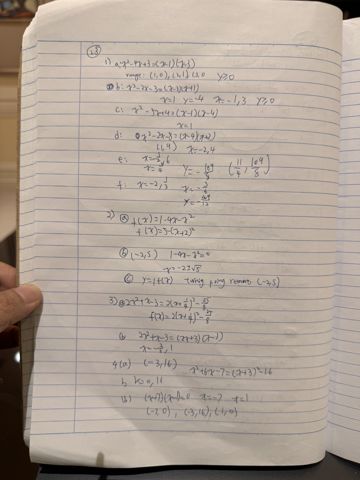
QQ1 (sketch |f(x)|, a–f)
✓ Correct
modulus graphs
Factorised each, found the roots and the turning points to reflect — incl. $(\tfrac{11}{4},\tfrac{169}{8})$ for $|2x^2-11x-6|$ ✓.
QQ2 ($1-4x-x^2$)
✓ Correct
completed square + |f|
$5-(x+2)^2$; vertex $(-2,5)$, roots $-2\pm\sqrt5$ ✓.
QQ3 ($2x^2+x-3$)
✓ Correct
completed square + |f|
$2(x+\tfrac14)^2-\tfrac{25}{8}$; roots $-\tfrac32, 1$ ✓.
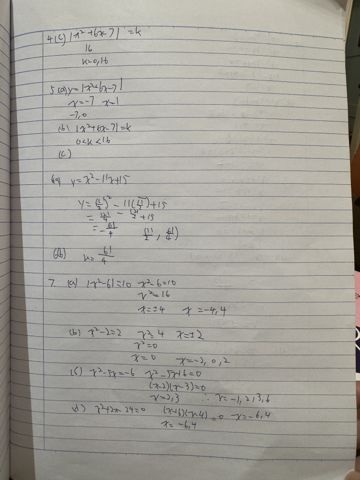
QQ4 (stationary point + 4 solutions)
◐ Partial
|(x-7)(x+1)|
(c) the range $0<k<16$ for four solutions is right (the peak value is 16).
Try this → (a) Re-expand $(x-7)(x+1)$: the middle term is $x-7x=-6x$, so it's $x^2-6x-7$ — roots $7,-1$ and stationary point $(3,16)$, not $(-3,16)$. You wrote $+6x$.
QQ5 (two solutions)
✗ Needs fixing
|(x+5)(x+1)|
Try this → Two issues: this curve is $|(x+5)(x+1)|$ — its turning point is at $x=-3$ with value $-4$, so the peak of $|f|$ is 4 (not 16). And for TWO solutions you need $k$ ABOVE the peak (or $k=0$); $0<k<\text{peak}$ gives FOUR.
QQ7 (solve |…|=…, a–d)
✓ Correct
modulus equations
$\pm4$; $-2,0,2$; $-1,2,3,6$; $-6,4$ — all correct, and you correctly dropped the cases with no real roots.
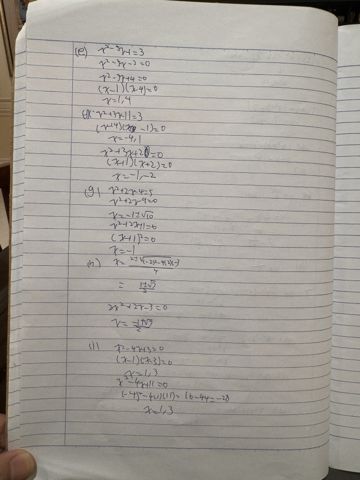
QQ7(e) (|x²−5x+1|=3)
◐ Partial
both cases of a modulus equation
You set up both cases and solved $x^2-5x+4=0\Rightarrow x=1,4$.
Try this → You left $x^2-5x-2=0$ unsolved — finish it with the quadratic formula to get the other two roots $\tfrac{5\pm\sqrt{33}}{2}$.
QQ7 (f–i)
✓ Correct
modulus equations
All correct — and in (i) you checked the discriminant of the second case ($-28<0$, no real roots). Exactly right.
View original answer pages