Cambridge IGCSE Chemistry (workbook) · Ch.4 continued, pp.34–35
Chemistry — Ch.4 (pp.34–35: giant structures & metallic bonding)
Graded 2026-06-18 · Sys4Ethan (Claude Opus 4.8 vision, human-verified)
To fix & review (3)Qp34 · Q3(a) describe structures Qp35 · Q2 metallic passage Qp35 · Q3 metallic diagram
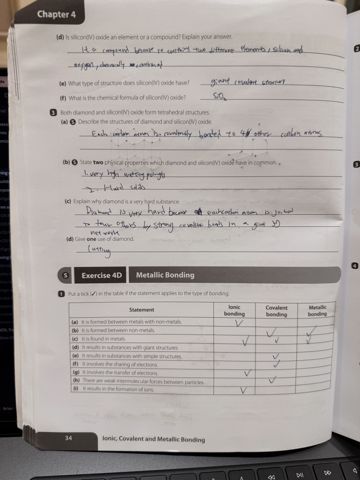
Qp34 · Q2(d–f) SiO₂
✓ Correct
compound / structure / formula
(d) compound — two different elements chemically combined ✓; (e) giant covalent structure ✓; (f) $\text{SiO}_2$ ✓.
Qp34 · Q3(a) describe structures
◐ Partial
diamond + SiO₂ structure
You described diamond (each C covalently bonded to 4 C).
Try this → Also describe silicon(IV) oxide: each silicon is covalently bonded to 4 oxygen atoms (and each oxygen to 2 silicons), giving the tetrahedral giant structure.
Qp34 · Q3(b) common properties
✓ Correct
giant covalent properties
Very high melting points + hard solids — both right.
Qp34 · Q3(c) why diamond is hard
✓ Correct
structure → property
Each carbon bonded to 4 others by strong covalent bonds in a giant 3D network ✓.
Qp34 · Q3(d) use of diamond
✓ Correct
uses
Cutting ✓.
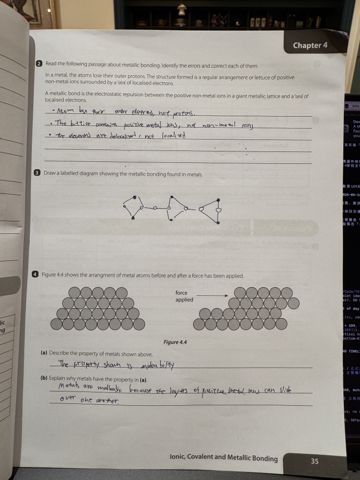
Qp35 · Q2 metallic passage
◐ Partial
spot & correct errors
Found 3 errors: protons→electrons, non-metal→metal ions, localised→delocalised. Good.
Try this → There's one more error — a metallic bond is the electrostatic ATTRACTION (not repulsion) between the positive metal ions and the sea of delocalised electrons.
Qp35 · Q3 metallic diagram
◐ Partial
labelled diagram
Try this → You drew the arrangement, but the question asks for a LABELLED diagram — label the positive metal ions and the 'sea' of delocalised electrons.
View original answer pages