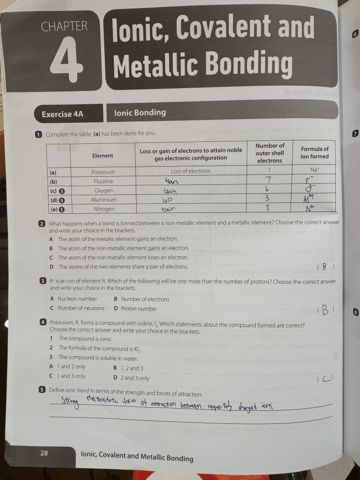
F⁻, O²⁻, Al³⁺, N³⁻ with the right outer-shell counts (7, 6, 3, 5) and loss/gain — all correct.
Qp28 · Q2✓ Correctionic bond formation (MCQ)
B ✓ — the non-metal gains an electron.
Qp28 · Q3✓ Corrections vs protons (MCQ)
B ✓
Qp28 · Q4✓ CorrectKI properties (MCQ)
C ✓ — KI (not KI₂); ionic; soluble.
Qp28 · Q5✓ Correctdefine ionic bond
Strong electrostatic force of attraction between oppositely charged ions — textbook-perfect.
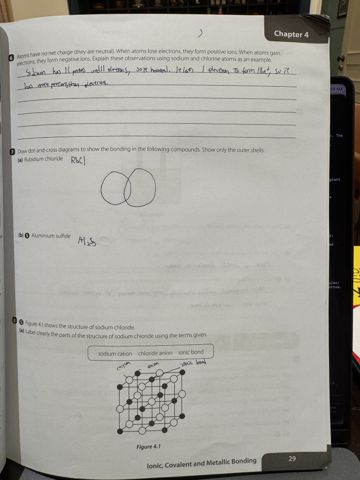
Qp29 · Q6◐ Partialexplain + / − ions
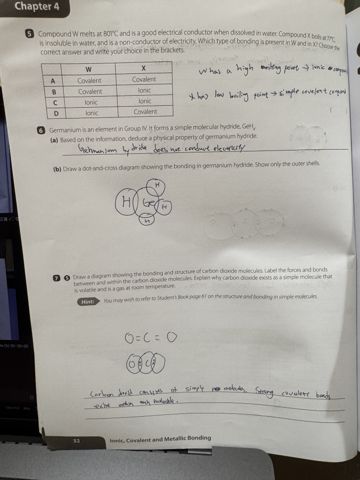
Try this → Sodium part is good (loses 1e⁻ → Na⁺, more protons than electrons). The question also needs chlorine: it GAINS 1e⁻ → Cl⁻, so more electrons than protons → negative.
Try this → RbCl is IONIC — electron transfer, not sharing. Don't draw overlapping (shared) circles. Show Rb giving its 1 outer electron to Cl, as separate ions in square brackets with charges $[\text{Rb}]^+\,[\text{Cl}\,]^-$. (You DID draw covalent ones correctly later — same idea, but transfer instead of share.)
Qp29 · Q7b Al₂S₃◐ Partialdot-and-cross (ionic)
Try this → Formula $\text{Al}_2\text{S}_3$ is right — but no diagram. Show 2 Al each losing 3e⁻ to 3 S (each gaining 2e⁻), drawn as ions with their charges.
Qp29 · Q8a✓ Correctlabel NaCl lattice
Cation / anion / ionic bond labelled.
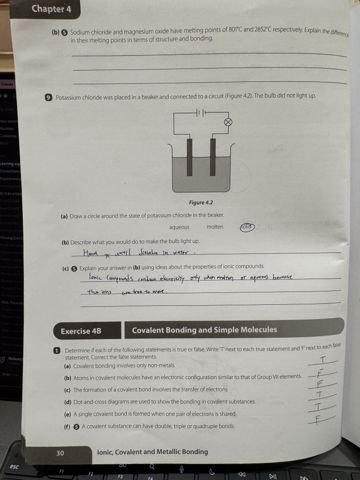
Qp30 · Q8b m.p.○ Not attemptedmelting point vs bonding
Try this → Left blank. Compare the charges: MgO is $\text{Mg}^{2+}/\text{O}^{2-}$ vs NaCl's $\text{Na}^+/\text{Cl}^-$ — bigger charges → stronger attraction → more energy to break → higher melting point.
Qp30 · Q9a✓ Correctstate from conductivity
Solid ✓ — a solid ionic compound can't conduct, so the bulb stays off.
Qp30 · Q9b◐ Partialmake it conduct
Try this → Your method is muddled. Give ONE clear way: either melt it (heat until molten) OR dissolve it in water — each frees the ions to move. Don't mix 'heat' with 'dissolve in water'.
Qp30 · Q9c✓ Correctwhy ionic conducts
Right — ionic compounds conduct only when molten or in solution because the ions are then free to move.
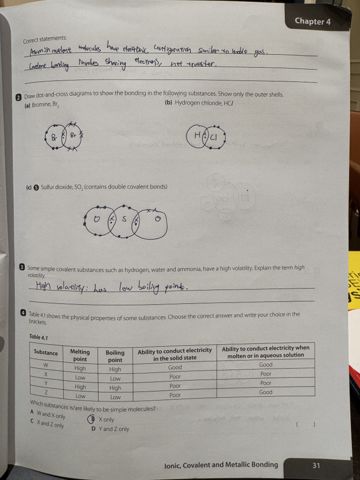
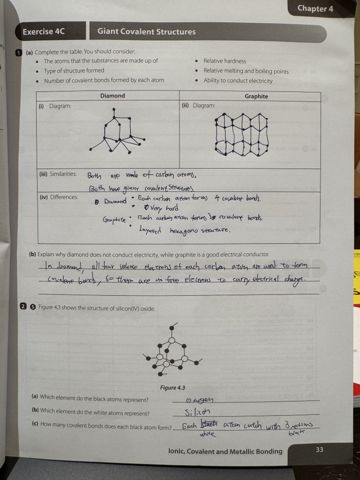
Diamond explained well (all 4 outer electrons bonded → no free electrons).
Try this → You explained diamond but stopped — now do graphite: each carbon uses only 3 of its 4 outer electrons for bonds, leaving 1 free/delocalised electron per atom that can move and carry charge.
Try this → (c) Re-count: each black (oxygen) atom bridges how many silicon atoms in the structure? You wrote 3 — look again at how many bonds an oxygen forms here.